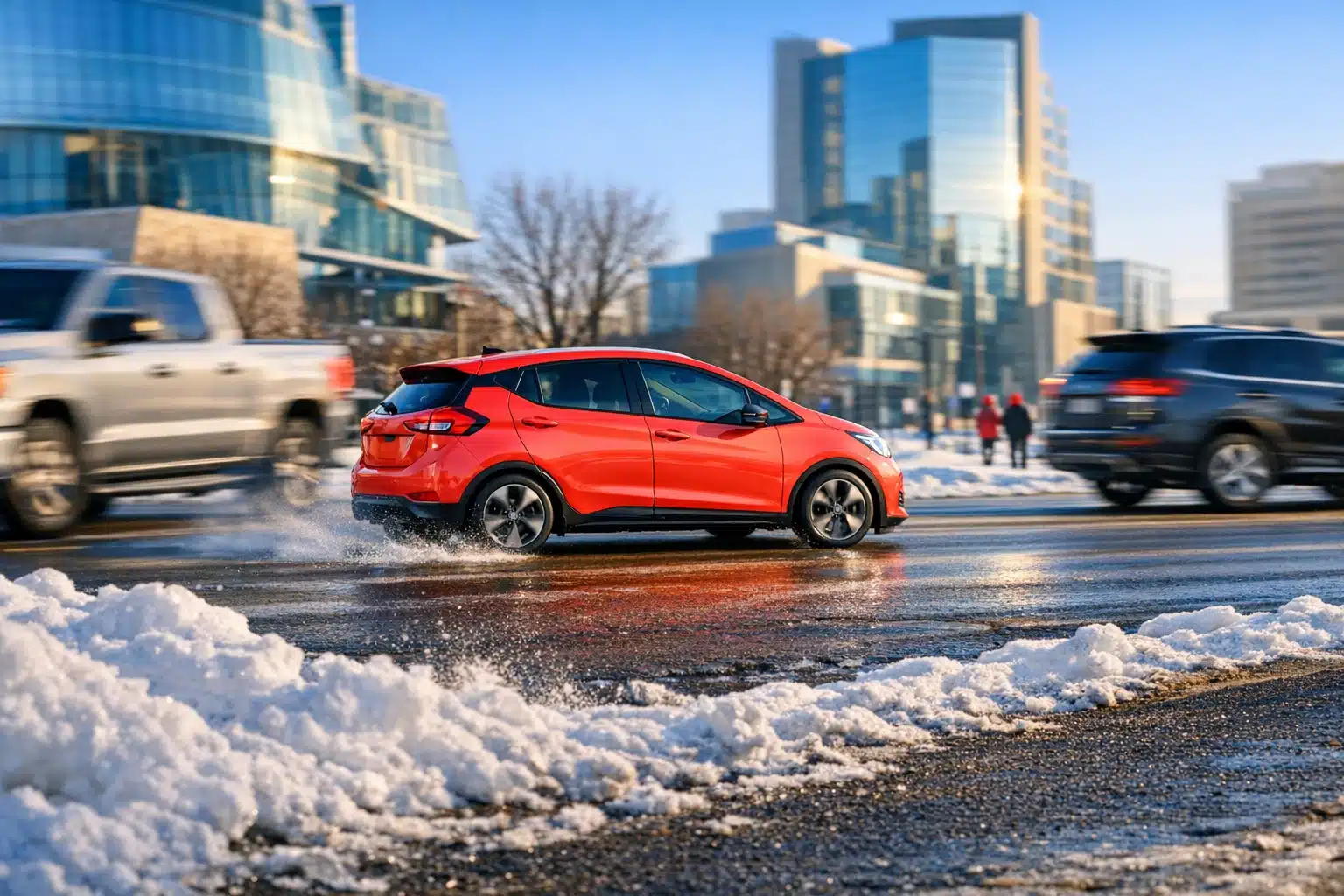
 Artificially generated image
 China’s $12K Electric Hatchback Is Turning Heads in Canada
When Canadians hear about a Chinese electric hatchback priced near the cost of a used compact, the reaction is usually a mix of curiosity and disbelief. The attention is less about novelty than about contrast: in a market where many new EVs still feel financially distant, a low-cost model becomes a lens on pricing, policy, and product strategy. Whether or not such a car arrives in showrooms soon, its presence in the global conversation matters. It challenges assumptions about what an everyday electric vehicle should cost and who it should serve.
Article Outline
- The price gap between low-cost Chinese EVs and what Canadians usually see in dealerships
- What a $12K electric hatchback actually offers in design, range, and technology
- Why importing or selling such a car in Canada is far more complex than the headline price suggests
- How this kind of vehicle compares with Canadian EV choices and what it could mean for affordability
- What Canadian drivers, families, and industry watchers should take away from the trend
Why This Tiny EV Has Become a Big Canadian Conversation
The reason a roughly US$12,000 Chinese electric hatchback draws so much attention in Canada is simple: it breaks the usual script. In the Canadian market, electric vehicles are often discussed as the future, but they are still priced for households with a fair amount of financial breathing room. Many new EVs sold in Canada begin well above C$40,000 before taxes and fees, and that means shoppers are not just comparing battery sizes or charging speeds. They are comparing aspirations with budgets. Against that backdrop, a low-cost Chinese city car feels less like a niche product and more like a challenge tossed onto the table.
Much of the discussion centers on vehicles such as the BYD Seagull, a compact hatchback sold in China at a price that can land around the US$10,000 to US$12,000 range depending on trim, timing, and exchange rates. That number alone has power. It forces Canadians to ask why a basic electric runabout can be so affordable in one market and still feel out of reach in another. The answer is not one thing. It is a blend of manufacturing scale, battery supply chains, local competition, regulation, trade policy, and buyer expectations.
Canada is especially sensitive to this conversation because the country sits in an awkward but important EV position. It wants broader electrification, it has invested heavily in battery and auto manufacturing, and it has consumers who are increasingly interested in lower operating costs. Yet it is also a large, cold country where many drivers want long range, family-sized vehicles, and highway comfort. That combination tends to push prices upward. A tiny hatchback from China therefore feels like a pebble dropped into a still lake; the ripples travel much farther than the car itself.
For Canadian readers, the fascination usually comes down to a few practical questions:
- Could a genuinely affordable EV expand the market beyond early adopters?
- Would urban commuters accept a smaller vehicle if the price were low enough?
- Can local automakers or established global brands respond with cheaper models?
- Is the real barrier technology, or is it policy and market structure?
That is why this story matters. It is not only about a single hatchback. It is about the shape of the next phase of electric mobility. For years, the EV discussion in Canada has often floated around premium features, long-range batteries, and ambitious targets. This car drags the topic back to the kitchen table, where people ask a more grounded question: what can I actually afford to park in my driveway, or on my street, right now?
What a $12K Electric Hatchback Actually Offers
The phrase “$12K electric hatchback” can sound like a magic trick, as if someone compressed a full-size modern EV into a bargain-bin price tag. In reality, cars in this category are not trying to do everything. They are built with a clear mission: affordable urban mobility. That means smaller dimensions, modest performance, a simpler cabin, and a battery sized for everyday commuting rather than cross-country bragging rights. Once you understand the intended use, the price begins to make more sense.
Vehicles often associated with this conversation typically offer a package designed for city life. A model like the BYD Seagull, for example, is a compact five-door hatchback with a relatively small battery pack, front-wheel drive, and a range figure that can look impressive on paper under China’s CLTC test cycle. Depending on version, publicly reported figures place range at roughly 300 to 400 kilometers under that standard. Canadians should read those numbers carefully, because CLTC ratings are generally more generous than EPA-style estimates and can look less impressive in winter. Even so, a short-range EV is not automatically a bad EV. For a commuter driving 30 to 50 kilometers per day, it can still be entirely workable.
These cars usually keep costs down through a combination of design choices and industrial advantages:
- Smaller batteries, often using lower-cost chemistry such as lithium iron phosphate
- Compact footprints that reduce material use
- Simpler interiors with fewer premium finishes
- Massive domestic manufacturing scale in China
- Tight vertical integration in batteries, electronics, and software
The result is a car that feels less like a luxury gadget and more like an appliance with personality. It gets people to work, to school, to the grocery store, and back home again. In dense urban settings, that is not a compromise; it is the point. There is even a certain charm to the idea. While much of the auto world keeps chasing larger screens, heavier bodies, and higher sticker prices, the affordable hatchback quietly asks whether a vehicle can simply be useful, efficient, and easy to own.
Still, the headline price requires context. A China-market starting price is not the same as a Canadian retail price. It does not include shipping, import duties, dealer margins, market-specific engineering, compliance costs, or local taxes. It also does not guarantee that a car tuned for Chinese roads, regulations, and consumer tastes will seamlessly fit Canadian needs. So while the spec sheet is genuinely intriguing, the number itself is only the opening line, not the full story. The car may be inexpensive in its home market, but turning that bargain into a Canadian showroom reality is a much harder engineering, legal, and commercial exercise.
Why Canadians Cannot Simply Buy One Tomorrow
If the story ended with exchange rates and internet excitement, Canadians might already be lining up for low-cost Chinese EVs. But the road from a Chinese factory to a Canadian driveway is crowded with obstacles. The most obvious is trade policy. In 2024, Canada moved to impose a 100 percent surtax on Chinese-made electric vehicles, sharply increasing the cost of direct imports. That step reflected broader geopolitical and industrial concerns, not just consumer pricing. In plain terms, it means the eye-catching home-market number attached to a Chinese hatchback is nowhere close to what a Canadian buyer would pay if the vehicle were imported under current policy.
Regulation is the next hurdle. Canada has its own safety and compliance requirements, and meeting them is not a matter of slapping on a bilingual sticker. A manufacturer generally needs to certify crash standards, lighting, occupant protection systems, software functions, and other details before a mass-market launch. There are also practical issues involving charging standards, parts supply, service infrastructure, and warranty support. A car can be cheap on paper, but if replacement components are difficult to source or repairs depend on a thin service network, buyers lose confidence very quickly.
Climate is another serious consideration. Canada is not just colder than many Chinese city markets; it also demands more from vehicles over long distances and at higher cruising speeds. An EV designed primarily for urban commuting may still work here, but it would likely need careful adaptation. Winter range loss, cabin heating efficiency, corrosion resistance, suspension tuning for rough roads, and tire packages all matter. The difference between surviving a mild commute and comfortably handling a January morning in Winnipeg is not small.
Several barriers shape the issue at once:
- Tariffs and trade restrictions that inflate the landing price
- Vehicle certification and compliance costs
- Charging connector and software ecosystem compatibility
- Dealer, repair, and parts support requirements
- Canadian expectations for winter reliability and highway performance
There is also a strategic dimension. Canada is trying to build its own EV supply chain, including battery plants and auto-sector investment tied to North American production. Welcoming a flood of ultra-cheap imports could clash with that industrial agenda. So the story is not simply “consumers want cheaper cars and policymakers are in the way.” It is a collision between affordability, national industry strategy, and global competition. That tension explains why the Chinese hatchback has become a talking point rather than a mainstream retail product. For now, it is easier to discuss than to buy.
How It Stacks Up Against EV Choices in Canada
To understand why the Chinese hatchback creates so much buzz, it helps to compare it with what Canadian shoppers actually face. A buyer looking for a new electric vehicle in Canada usually enters a market where prices rise quickly. Compact and subcompact EVs exist, but they are rarely “cheap” in the everyday sense of the word. Models such as the Nissan Leaf, Hyundai Kona Electric, Chevrolet Equinox EV, Tesla Model 3, and Mini electric offerings all sit in price territory that can strain entry-level budgets, especially once financing costs, insurance, winter tires, and home charging equipment are considered.
This is where the China-market hatchback changes the tone of the conversation. Even if its realistic Canadian landed price would be far higher than the headline US$12,000, it still suggests a missing category: the truly affordable new EV for city drivers. Not everyone needs a crossover, a long-range battery, or a premium interface. Some people need a second household car, a commuter for suburban rail stations, or a modest urban runabout that cuts fuel bills without stretching the mortgage.
In a straight comparison, a low-cost Chinese hatchback would likely trade away several things Canadian buyers often expect:
- Less highway-oriented power and acceleration
- Shorter real-world range, especially in cold weather
- Smaller cargo space and tighter rear seating
- Potentially fewer advanced comfort and driver-assist features
But it could also deliver advantages that matter just as much to a certain audience:
- Lower upfront cost
- Lower energy use in urban driving
- Easier parking and maneuverability
- Simpler ownership for short-distance routines
There is another angle here that often gets overlooked: competition. When consumers see a small EV sold elsewhere for a fraction of the price of many local options, they begin to question how today’s product mix was shaped. That does not automatically mean Canadian-market EVs are overpriced in a simplistic sense. North American vehicles often have larger batteries, stronger performance, and different regulatory and manufacturing costs. Still, the comparison is valuable because it reveals how much of the current market has drifted toward higher-margin segments.
For shoppers, the emotional difference is enormous. A C$45,000 EV is a serious financial commitment. A hypothetical C$20,000 to C$25,000 city EV, if it could ever be offered with proper support and compliance, would open a very different kind of conversation. It is the difference between asking, “Can I justify this?” and asking, “Would this fit my life?” That gap explains why Canadians keep paying attention to cars they cannot easily buy. They are not only admiring a cheap hatchback. They are imagining a market that feels more inclusive.
Conclusion: What Canadian Drivers Should Watch Next
For Canadian readers, the most useful takeaway is not that a US$12,000 Chinese hatchback is about to transform local dealerships overnight. It is that the car has become a benchmark. It gives consumers a reference point, and reference points matter. Once people see that basic electric transportation can be produced at much lower cost in another market, they start asking sharper questions about pricing, policy, and product design at home. That is healthy for the market, even if the specific vehicle never becomes a familiar sight in Canadian parking lots.
The bigger lesson is that affordability may become the next major battleground in the EV transition. Early phases of electrification rewarded brands that could sell technology, performance, and image. The next phase may reward those that can deliver competent, durable, efficient cars at prices ordinary households can manage. In that sense, the Chinese hatchback is less a curiosity than a signal flare. It tells automakers and policymakers that many buyers are still waiting at the bottom of the market, not the top.
Canadian drivers should keep an eye on several developments:
- Whether mainstream automakers launch smaller and cheaper EVs for North America
- How tariff policy shapes the range of vehicles available to consumers
- Improvements in battery costs and cold-weather efficiency
- The growth of the used EV market as a practical affordability bridge
- Charging access for apartment dwellers and urban residents
For families in major cities, students, commuters, and cost-conscious households, this conversation is especially relevant. A low-cost hatchback may not replace every vehicle type Canadians need, and it will not solve charging infrastructure or winter-performance concerns by itself. But it highlights a market gap that is impossible to ignore. There is demand for smaller, simpler, cheaper EVs. Whether that demand is eventually met by Chinese brands, North American production, or a new wave of global partnerships remains to be seen.
In the end, the little hatchback matters because it asks a very big question: can the electric future become ordinary rather than aspirational? For Canada, that question is more important than any single model. The answer will shape who gets to participate in the EV transition, and how quickly that transition becomes part of everyday life instead of a premium-tier experiment.